- Overview
- Design
- Systems
- Blog

Grid-tie Solar
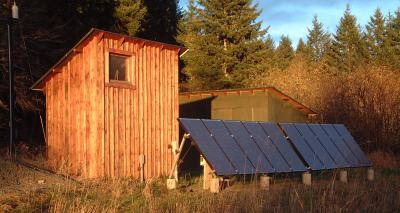 Auerhaus
is the first grid-tied solar house on the West
Oregon Electric Co-op system. It's just me and Bonneville
Power.
I probably wouldn't have put up solar in cloudy Oregon except for having
bartered for it. In all the hardware was probably $15,000. This doesn't
include the electrical shed (built with scrap) and my time (I did all
the electrical work on the house).
Auerhaus
is the first grid-tied solar house on the West
Oregon Electric Co-op system. It's just me and Bonneville
Power.
I probably wouldn't have put up solar in cloudy Oregon except for having
bartered for it. In all the hardware was probably $15,000. This doesn't
include the electrical shed (built with scrap) and my time (I did all
the electrical work on the house).
My system is small. 1500 watts of panels, a 3600 watt inverter and
400 amp-hours worth of batteries. It's 110-volt only (but could be
made 220). I located the panels on the hill above the house for several
reasons: better solar access, freed up the house roof design, minimized
the DC wiring, and was simpler to install and maintain. In the 5 months
it has been live, I've put about 600 kilowatt-hours back on the grid.
About $66. I've generated more, but I don't track how much of my own power I use. My electrical
bill is about $45/month so my bill will not be zero. I figure I would
need 3-times as many panels to get to net-zero. Maybe in 20 years,
the life of the panels, I'll be able to replace them with panels that
are 3-times as efficient in the same space.
The best thing has been the battery backup. We are subject to frequent outages in winter. It is comforting to have some lights, outlets and the fridge remain on during a storm. And it is essential that my UV water purifying equipment stay on. I have about 36-hours of backup power if there is little or no sun to recharge the batteries. Since our outages are typically 3 to 5 hours, I'll likely hook more up to the backed-up circuits.
>Design
.gif) For those who are interested click on the schematic for
a large, printable version of the wiring diagram. I used electronics
by Outback Solar.
Great product made by geeks and marketed by geeks. My panels are from
BP.
You know, "beyond petroleum," not! I chose sealed, AGM batteries
from Concorde for the no maintenance aspect.
For those who are interested click on the schematic for
a large, printable version of the wiring diagram. I used electronics
by Outback Solar.
Great product made by geeks and marketed by geeks. My panels are from
BP.
You know, "beyond petroleum," not! I chose sealed, AGM batteries
from Concorde for the no maintenance aspect.
I wasn't that impressed with how my UniRac mounting system assembled, but maybe it's improved by now. The panels didn't blow away in the windstorms this year, and that's the most important thing.
I did find it was easier to stick with one brand for other parts like DC-breaker boxes. In fact getting easily understood wiring diagrams and information on these other parts proved a surprising challenge. I did wire it myself, but I did almost make a big mistake.
Unless one has a system big enough to handle the whole electrical load, you have to have two separate panels. One that runs off solar/battery (critical circuits), and one that runs only off the grid. The inverter automatically switches from grid to battery in the blink of an eye. I also used a big, fancy switch to enable me to switch the critical circuits to grid in case the inverter or batteries failed.
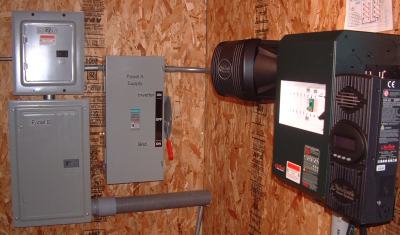 One bone of contention was the need for a main cut-off switch on the
outside so a lineman could make sure it was disconnected and not energizing
a line they were working on. This is where one enters a murky area in
jurisdictions that don't do many such systems. The planning department
approved a meter base with a main breaker disconnect. Six months after
the house finaled, and I wanted to connect my solar system the electric
company wanted me to install a very expensive breaker switch. The problem,
the breaker switch position had to visible from a distance. When we discussed
it with the linemen, they didn't need it. I didn't need it. And as it
turns out modern inverters meet a UL disconnect spec that eliminates
the need for a breaker at all. I Would still recommend a disconnect in
the meter base because it enables one to work in safety on the sub panels.
One bone of contention was the need for a main cut-off switch on the
outside so a lineman could make sure it was disconnected and not energizing
a line they were working on. This is where one enters a murky area in
jurisdictions that don't do many such systems. The planning department
approved a meter base with a main breaker disconnect. Six months after
the house finaled, and I wanted to connect my solar system the electric
company wanted me to install a very expensive breaker switch. The problem,
the breaker switch position had to visible from a distance. When we discussed
it with the linemen, they didn't need it. I didn't need it. And as it
turns out modern inverters meet a UL disconnect spec that eliminates
the need for a breaker at all. I Would still recommend a disconnect in
the meter base because it enables one to work in safety on the sub panels.
>Effect on Electric Bill
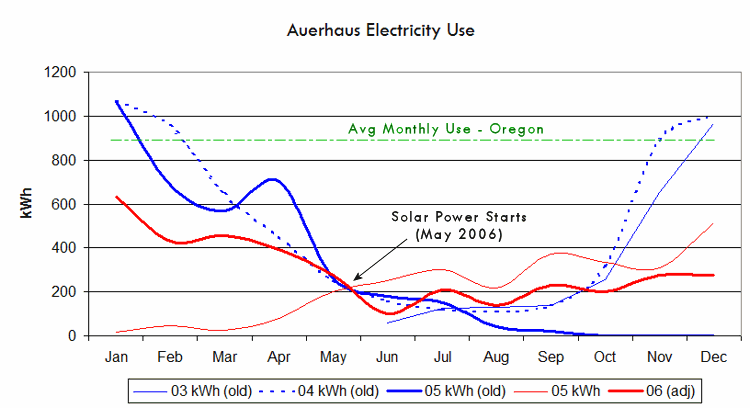
The blue lines on the chart represent my electricity use in the old manufactured home with electric heat (2003 -2005). The 2006 line is "adjusted" (adj) down because my utility's remote reporting unit reports the amount I put on the grid as a debit instead of a credit. I am on track to use a net of about 3,600 kWh from the grid annually. About 1/3rd the average per capita use of 12,000 kWh. I estimate my system is generating about 1000 to 1200 kWh annually. Thus my estimate that I would need 3 times the number of panels to go off-grid.
© Copyright 2007 Auerhaus.org